


By Micah Jonah
January 26, 2026
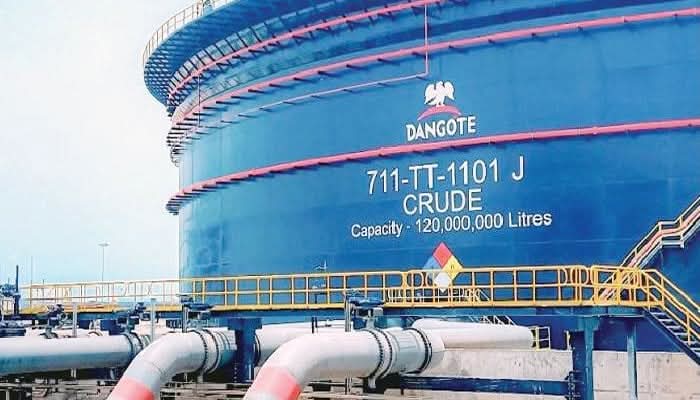
The Dangote Petroleum Refinery has adjusted its crude processing strategy by switching to lighter crude oil grades in order to sustain production, reduce the impact of prolonged downtime at its Residual Fluid Catalytic Cracker unit.
Industry intelligence firm Kpler disclosed that the refinery has increasingly processed lighter crude with higher API gravity since the last quarter of 2025, a move aimed at preserving feedstock for key secondary processing units and maintaining output of petrol and middle distillate products.
According to the report, the shift has allowed critical units such as the Continuous Catalytic Reformer, isomerisation and hydrocracking facilities to remain operational, thereby preventing major disruptions in fuel supply despite the continued unavailability of the 200,000 barrel per day cracking unit.
Kpler noted that although the refinery continues to operate below its full capacity, the lighter crude slate has played a significant role in stabilizing operations while efforts to restore the affected unit remain ongoing.
The firm estimated that crude runs in January ranged between 280,000 and 300,000 barrels per day and are expected to rise slightly to between 300,000 and 320,000 barrels per day in February, depending on the pace of recovery of the affected processing unit.
It further projected that refinery operations could improve gradually from the third week of February if the restart of the cracking unit proceeds as scheduled, potentially allowing average runs of about 350,000 barrels per day in the first quarter of 2026 and about 400,000 barrels per day in the first half of the year.
To support petrol production, the refinery has also increased imports of gasoline blending components, with January inflows estimated at about 45,000 barrels per day, helping to supplement output from internal conversion units.
Despite these efforts, analysts warn that full operational stability may still be several months away, noting that large scale refineries often experience extended ramp up periods, particularly when critical conversion units face reliability challenges.
Market observers say extended stabilization timelines are common for mega refineries worldwide, with steady operations sometimes taking between two and three years to achieve, depending on technical complexity and operational conditions.
The Dangote Petroleum Refinery, Africa’s largest single train refinery, is expected to play a major role in reducing Nigeria’s dependence on imported refined petroleum products and easing pressure on foreign exchange once full capacity is achieved.
Energy experts believe that sustained technical improvements, stable unit performance will be key to achieving consistent fuel supply and long term operational efficiency at the facility.