By Micah Jonah | January 25, 2026
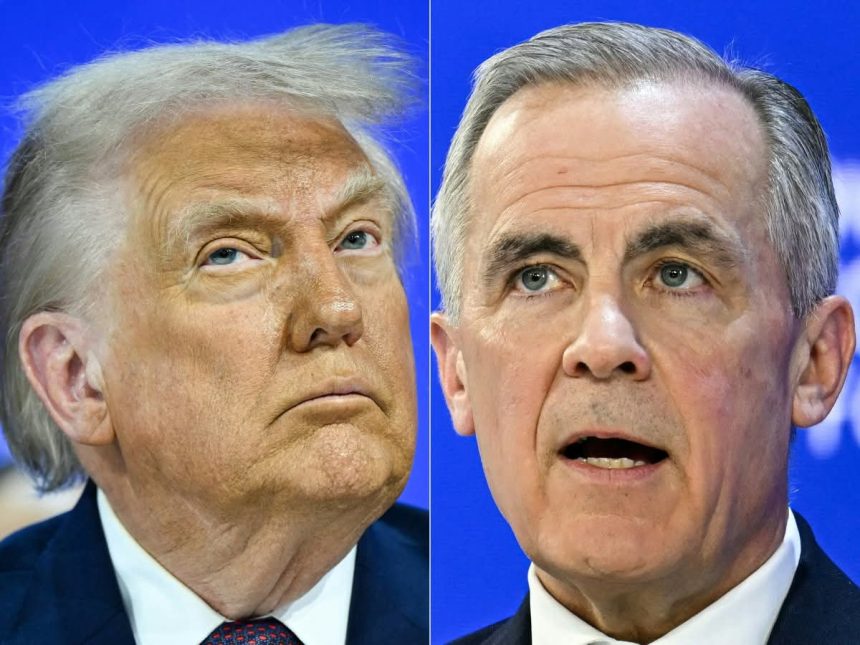
United States President, Donald Trump has threatened to impose a 100 percent tariff on all Canadian goods if Canada proceeds with a newly announced trade arrangement with China.
Trump issued the warning on Saturday through a post on his Truth Social platform, accusing Canada of attempting to serve as a transit route for Chinese goods into the United States.
He said Canada would face immediate trade penalties if it allows Chinese products to access the American market through Canadian channels, describing such action as unacceptable under U.S. trade policy.
The threat follows an agreement reached last week between Canada and China covering agricultural products and electric vehicles, which aims to reduce tariffs on Canadian exports while allowing a fixed number of Chinese electric vehicles into the Canadian market.
Canada’s Minister responsible for Canada-U.S. trade, Dominic LeBlanc, later clarified that Ottawa is not pursuing a free trade agreement with Beijing, describing the recent deal as a resolution of specific tariff disputes rather than a full trade pact.
He added that the Canadian government remains focused on strengthening its domestic economy while expanding trade partnerships across multiple regions.
Tensions between Washington and Ottawa have risen sharply in recent days following remarks made by Canadian Prime Minister, Mark Carney at the World Economic Forum in Davos, where he called for stronger cooperation among mid-sized economies amid growing global economic pressure.
Trump reacted to the speech by warning that Canada depends heavily on the United States for economic survival, later withdrew an invitation for Carney to participate in his proposed international “Board of Peace.”
Relations between both countries have continued to deteriorate since Trump returned to office, with repeated tariff threats, renewed calls by the U.S. President for Canada to be more economically aligned with Washington.
The growing dispute has pushed Canada to strengthen trade relations with other partners, including China, the European Union and Middle Eastern countries, as it seeks to reduce dependence on the U.S. market.
The Canada-China agreement announced last week allows reduced tariffs on key Canadian agricultural exports such as canola, while permitting controlled entry of Chinese electric vehicles into Canada.
Canadian officials say the arrangement is part of broader efforts to diversify the country’s economic partnerships, protect national economic stability amid increasing global trade tensions.