By Micah Jonah
January 22, 2026
Political campaigning has begun across Bangladesh as the country prepares for its first national election since the 2024 uprising which removed longtime Prime Minister Sheikh Hasina from power, in what many observers describe as the most critical vote in the nation’s modern history.
Major political parties on Thursday held rallies in the capital Dhaka and in regional cities ahead of the February 12 election, which will determine both the next government and the future direction of political reforms introduced by the interim administration.
The caretaker government is led by Nobel Peace Prize laureate Muhammad Yunus, who returned from exile in August 2024 at the request of protest leaders and now serves as chief adviser. Yunus has promised to oversee a free and fair election and has pledged to step down after the polls.
Bangladesh, with a population of about 170 million, will elect 350 lawmakers. European Union election observers described the vote as the biggest democratic process of 2026, noting that it will also decide whether sweeping political reforms will be written into the constitution.
Yunus said he inherited what he described as a completely broken political system and introduced a reform charter aimed at preventing a return to authoritarian rule. A referendum on the reforms will be held on the same day as the election.
The July National Charter, named after the protest movement that began in July 2024, proposes increasing the powers of the presidency to balance the previously dominant prime minister’s office. It also recommends term limits for lawmakers and stronger measures against corruption, money laundering and conflicts of interest. The charter was signed by 25 of the country’s 52 registered political parties last year, but supporters say a referendum is required to make the reforms legally binding.
Sheikh Hasina, who ruled for 15 years, was sentenced to death in absentia in November for crimes against humanity related to the deadly crackdown on protesters during the uprising. She remains in India, where she fled after demonstrators stormed her residence.
Her former party, the Awami League, has been barred from contesting the election after the Election Commission suspended its registration in May, effectively removing it from the political contest.
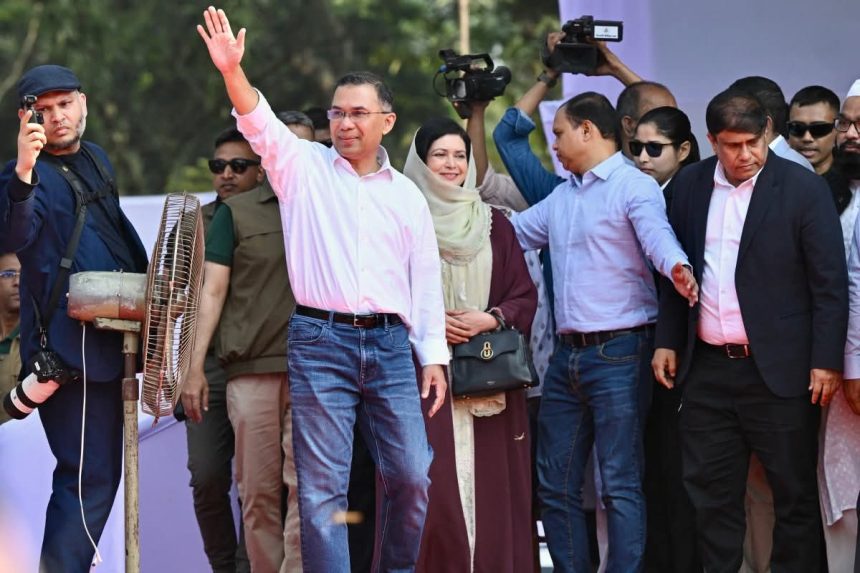
The Bangladesh Nationalist Party led by Tarique Rahman is widely viewed as a leading challenger for power. Rahman, the son of former Prime Minister Khaleda Zia, returned to Bangladesh in December after 17 years in exile and launched his campaign in the northeastern city of Sylhet, where tens of thousands of supporters gathered, chanting his name.
Supporters described him as continuing the political legacy of his parents, including his father Ziaur Rahman, a former president who was assassinated in 1981.
A 10 party alliance led by Jamaat e Islami is also seeking to expand its influence after years of repression under the Hasina government. The party has historically faced criticism from secular groups who argue that its political positions challenge Bangladesh’s constitutional secular foundations.
Supporters of the Jamaat led alliance said they are seeking new leadership and believe the party has a cleaner public image compared with traditional political elites.
Meanwhile, Yunus warned that the election process is being threatened by disinformation campaigns spreading through social media and foreign based platforms. He accused unnamed foreign and domestic actors of spreading false reports, rumors and political manipulation aimed at destabilizing the transition process.
Relations between Bangladesh and neighboring India remain tense after Hasina sought refuge in New Delhi, a move that angered many protesters who accuse India of backing her former government.
With political passions rising and reforms hanging in the balance, the February 12 vote is expected to shape Bangladesh’s democratic future and determine whether the country can move beyond years of political violence and authoritarian control.