By Micah Jonah
January 11, 2026
Joint naval exercises involving members of the BRICS bloc have begun off the coast of South Africa, underscoring growing geopolitical tensions and divergent interests within the group as two founding members, India and Brazil, opted not to participate fully.
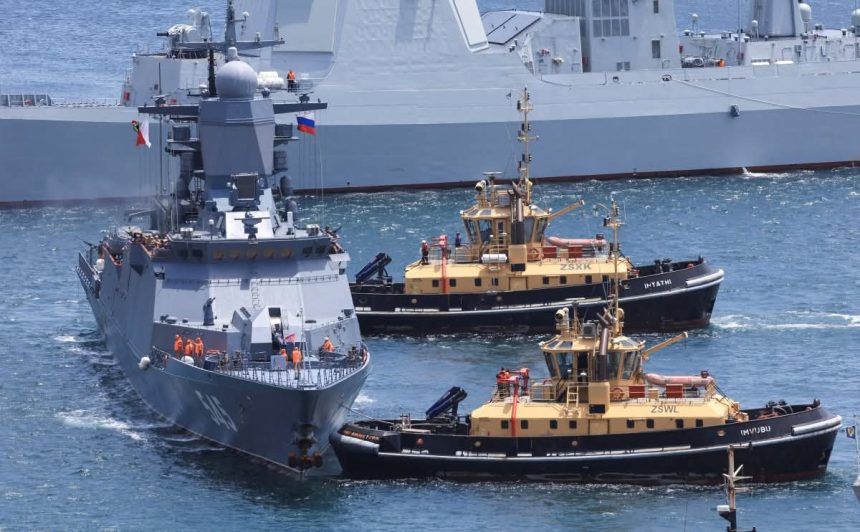
The weeklong drills, dubbed Will for Peace 2026, kicked off on Saturday at Simon’s Town, where the Indian Ocean meets the Atlantic. Led by China, the exercises involve China, Russia, Iran, South Africa and the United Arab Emirates, with several other countries observing.
South Africa, the host nation and current BRICS chair, described the manoeuvres as essential to safeguarding maritime trade routes and ensuring the safety of maritime economic activities amid rising global tensions.
Chinese and South African officials said the drills include rescue missions, maritime strike simulations and technical exchanges, presenting them as cooperative rather than confrontational.
However, the exercises come at a sensitive time. Relations between South Africa and the United States have deteriorated since President Donald Trump returned to office, with Washington viewing BRICS as both an economic and strategic challenge. The drills began just days after the United States seized a Venezuela linked Russian oil tanker in the North Atlantic, escalating already strained relations.
Trump has openly accused some BRICS members of pursuing anti American agendas, has threatened the bloc with additional tariffs. He has also warned of military action against countries he sees as hostile to US interests, including Iran and Venezuela, and has made controversial remarks about Greenland.
While China, Russia and Iran see the drills as a show of unity and resolve, India and Brazil have taken a more cautious approach.
Brazil joined the exercises only as an observer, while India stayed away entirely. Analysts say New Delhi’s decision reflects its effort to balance relations with Washington, particularly as trade tensions with the US intensify over India’s continued purchase of Russian oil.
Geopolitical analyst, Harsh Pant said the naval drills fall outside BRICS’s original mandate, noting that the bloc was never designed as a military alliance but as an economic partnership aimed at reducing reliance on Western dominated systems.
For South Africa, hosting the drills carries both strategic value and diplomatic risk. The country has already faced criticism from Western nations for previous joint exercises with China and Russia and is under pressure following its genocide case against Israel at the International Court of Justice.
Opposition parties within South Africa have also criticized the exercises, warning that they could turn the country into a pawn in wider global power struggles.
As global tensions rise, the BRICS drills highlight both the bloc’s ambitions and its internal divisions, raising questions about how far it can evolve beyond economic cooperation into deeper strategic alignment.