By Micah Jonah
January 9, 2026
Two meetings held almost simultaneously in late December underscored the competing strategic visions reshaping the Eastern Mediterranean and the wider Levant, as Israel, Greece and Cyprus deepen cooperation while Turkiye consolidates its influence in post-Assad Syria.
On December 22, Turkiye’s foreign defence and intelligence chiefs met Syrian officials in Damascus, signalling Ankara’s continued focus on stabilization and the consolidation of state authority, following the fall of Bashar al-Assad’s government.
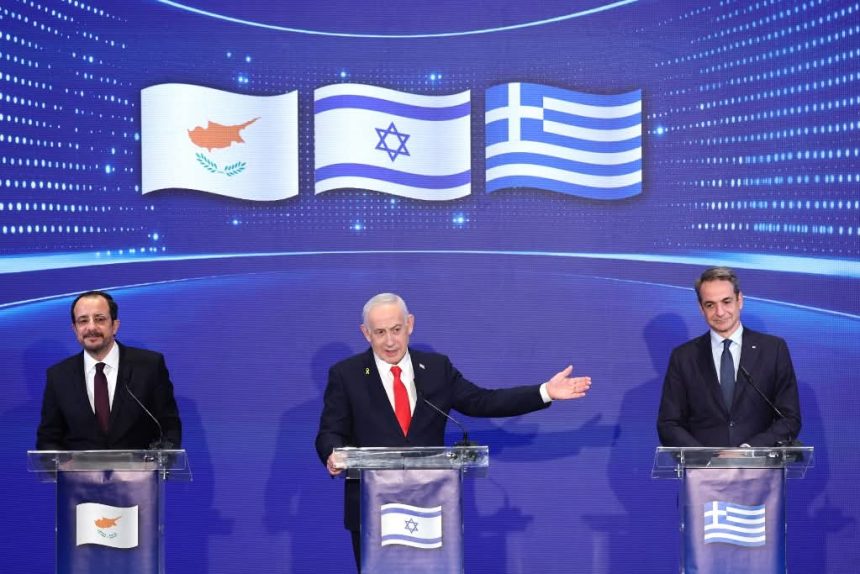
On the same day, Israel hosted Greek Prime Minister Kyriakos Mitsotakis and Cypriot President Nikos Christodoulides in Jerusalem under their trilateral cooperation framework. Two days earlier, Israel had launched another air attack on Syria, one of more than 600 strikes carried out in 2025, reinforcing Ankara’s view that Israel is prepared to disrupt Syria’s recovery.
Although officially centred on energy cooperation and regional connectivity, the Israel-Greece-Cyprus framework has steadily expanded into security coordination and military alignment, marking a shift from economic rivalry to strategic containment.
Cem Gurdeniz, a retired Turkish admiral and one of the architects of Turkiye’s “Blue Homeland” maritime doctrine, described the trilateral alignment as an effort “to exclude and encircle Turkiye”.
“The objective is not war, rather behavioural change, narrowing Turkiye’s strategic space to induce withdrawal without conflict,” Gurdeniz said, warning against viewing the rivalry as a routine energy dispute.
For Israel, analysts say the partnership reflects unease with Turkiye’s Syria policy, which prioritizes territorial integrity and the restoration of central authority, an outcome that runs counter to Israel’s preference for a fragmented regional security environment.
Greece and Cyprus, meanwhile, see the trilateral mechanism as a means to advance maritime boundary claims and energy corridors that would marginalize Turkiye’s role in the Eastern Mediterranean.
Security cooperation now forms a core pillar of the arrangement, according to Muzaffer Senel, a visiting scholar at Marmara University. He said all three countries view Turkiye as a common rival, have sought to create faits accomplis through unilateral initiatives.
The decision to host the meeting in Israel also reflected Israel’s shrinking diplomatic space as its war on Gaza deepens international isolation. With Prime Minister Benjamin Netanyahu facing an arrest warrant from the International Criminal Court, his ability to travel to ICC member states such as Greece and Cyprus has become increasingly constrained.
Standing alongside his Greek and Cypriot counterparts, Netanyahu warned that “those who fantasize they can re-establish their empires” should “forget it” remarks widely interpreted as directed at Turkiye.
Longstanding maritime disputes continue to fuel tensions. Greece argues that its Aegean islands generate full exclusive economic zones, a claim Turkiye rejects, insisting maritime boundaries should be drawn from the mainland. Cyprus remains another flashpoint, divided since Turkiye’s 1974 intervention following a Greek Cypriot coup.
These disputes have provided Israel with an opening to deepen its involvement in the Eastern Mediterranean, with Greece seeking to leverage Israel’s close ties with Washington to strengthen its diplomatic position.
While no formal defence pact exists, cooperation among the three states is becoming increasingly institutionalized, including under a “3+1” format that involves the United States ,a move Ankara views as a clear strategic signal.
Relations between Israel, Greece and Cyprus have not been hindered by Israel’s war on Gaza, even as several European states have criticized Israel for violations of international law. Defence ties have instead expanded, with Greece approving major arms purchases from Israel and Cyprus acquiring Israeli-made air defence systems.
Turkish officials have sought to downplay the trilateral meeting. Defence ministry spokesperson Zeki Akturk said it “does not pose a military threat to Turkiye”, while President Recep Tayyip Erdogan reiterated that Ankara would not allow violations of its rights in the Aegean or Mediterranean.
At the same time, Turkiye has accelerated naval investments, embarking on its largest procurement programme to date, driven by lessons from maritime standoffs with Greece since 2020.
Analysts warn that Turkiye risks underestimating a broader pattern of Israeli pressure across multiple theatres, from Syria to the Eastern Mediterranean and, more recently, the Horn of Africa – following Israel’s recognition of Somaliland.
In Syria, Israeli strikes on key government sites have been widely seen as attempts to weaken state consolidation, reinforcing Turkish concerns that Israel favours instability along Turkiye’s southern flank.
Taken together, analysts say Israel’s actions amount to a dual-pressure strategy aimed at constraining Turkiye’s influence without direct confrontation.
“The strategic risk for Turkiye is gradualism,” said Andreas Krieg, an associate professor at King’s College London. “Ankara’s objective should be explicit: prevent a permanent Israeli security carve-out in southern Syria, an Eastern Mediterranean order that boxes Turkiye in.”
Krieg added that Turkiye would need to rely on practical diplomatic, strategic measures rather than rhetoric, if it hopes to counter what it perceives as an emerging containment axis.