By Micah Jonah
January 8, 2026
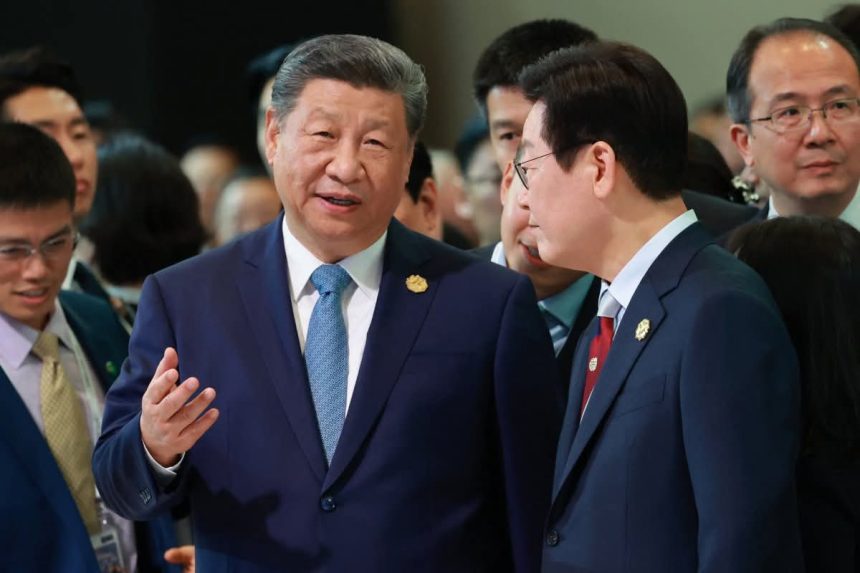
South Korean President, Lee Jae Myung will visit Beijing for a second summit with Chinese President Xi Jinping, underscoring China’s intent to strengthen ties with Seoul amid shifting regional dynamics.
Lee will meet Xi in Beijing before traveling to Shanghai to visit the historic site of South Korea’s provisional government during Japan’s 35-year colonial rule. The leaders are expected to discuss practical cooperation in areas including supply-chain investment, tourism, and responses to transnational crime. Lee will also seek China’s support in advancing dialogue on Korean Peninsula issues.
This will be the second meeting between the two leaders in just two months, reflecting Beijing’s focus on reinforcing relations with South Korea ahead of its next summit with Japan. Relations between China and Japan remain strained after Japanese Prime Minister, Sanae Takaichi suggested a potential military response if China attacks Taiwan.
South Korea reaffirmed its adherence to the one China policy while maintaining independent relations with Taiwan. The Lee administration has emphasized “practical diplomacy,” aiming to restore strong ties with China while sustaining relations with Japan and the United States.
The summit may also address the South Korea-U.S. alliance, with roughly 28,500 U.S. troops stationed in South Korea. Lee is expected to seek Beijing’s help in encouraging dialogue with North Korea, whose leader Kim Jong Un has continued close coordination with China.
Trade and technology cooperation will feature prominently, including critical minerals, green industries, and AI. South Korea relies on China for nearly half of its rare earth minerals, essential for semiconductor production, and as the largest market for its chip exports. Huawei is set to launch its Ascend 950 AI chips in South Korea next year, offering an alternative to U.S.-based Nvidia.
Lee’s delegation will include business and cultural leaders, with discussions potentially covering the long-standing Chinese restrictions on K-pop content and broader cultural exchanges. The visit highlights both nations’ efforts to stabilize strategic, economic, and cultural relations amid a complex regional environment.