By RismadarVoice Reporters
January 5, 2026
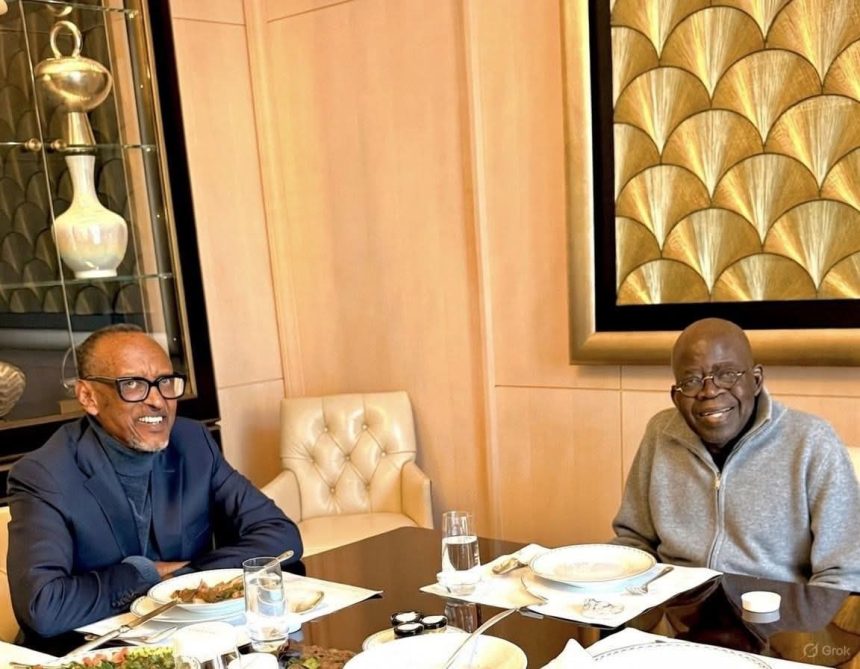
A photograph shared from President Bola Tinubu’s reported meeting with Rwandan President Paul Kagame in Paris has triggered debate on social media after users observed a Grok watermark on the image.
President Tinubu was said to have met President Kagame on Sunday in Paris, France. However, the photograph posted on the President’s verified X (formerly Twitter) account carried the watermark of Grok, a generative artificial intelligence chatbot developed by xAI, the AI company owned by Elon Musk.
Grok is known for its real-time search, image generation, and other AI-powered capabilities.
The same image was also shared by the Special Assistant to the President on New Media, Dada Olusegun, further amplifying reactions and scrutiny on social media.
Several users questioned why an image bearing an AI watermark was used to document what was described as a high-level diplomatic engagement.
An X user, Olayinka (@mickoly), wrote:
“Where in Europe is Tinubu? Why post #Grok generated photo? No real photo from the meeting?”
Another user, Joshua Siyanbola (@JoshuaSiyanbol4), commented:
“The picture seems to be AI generated image. In fact, it carries Grok signature. I believe we can do better.”
Also reacting, Attorney General of the Unborn Nation (@sonickay) criticised the post, saying:
“The image has Grok watermark at the bottom right corner. You should tell us where your principal is and what he is doing there rather than using AI images.”
Similarly, an anonymous user, Gospel Logic (@GospelLogic), wrote:
“Grok logo gave you out bro, you could have edited it out.”
As of the time of filing this report, the Presidency and President Tinubu’s media aides had not issued any official clarification on the origin of the image or the reason for the presence of the Grok watermark.
The incident has reignited broader conversations on the use of artificial intelligence in official government communication, as well as concerns over authenticity, transparency, and public trust in the dissemination of state information.