RismadarVoice Reporters, April 26, 2026
The Catholic Bishop of Sokoto Diocese, Most Rev. Dr Matthew Hassan Kukah, has called on Nigerians to stop referring to him as a Hausa man, clarifying that he is not of Hausa origin.
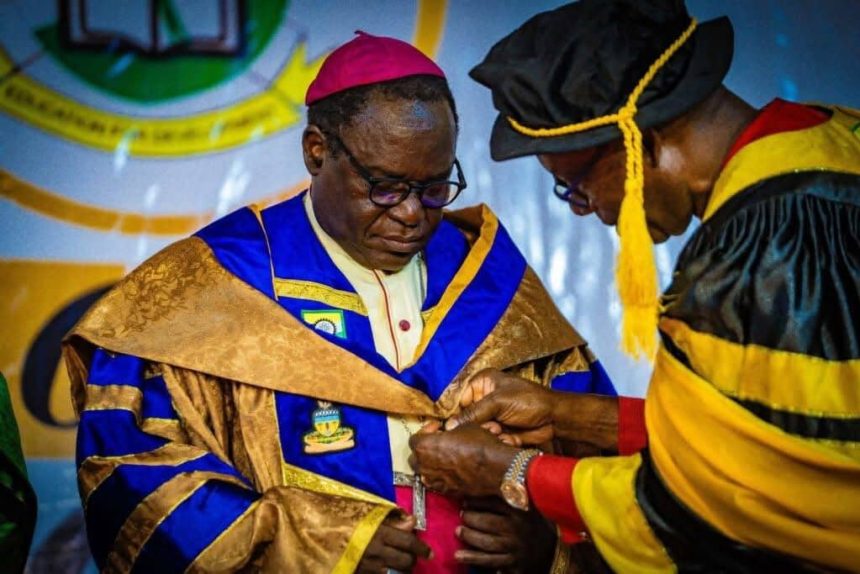
Kukah remarked on Saturday during the 16th Convocation Ceremony of Chukwuemeka Odumegwu Ojukwu University (COOU), Igbariam, Anambra State, where he was formally installed as Chancellor of the institution.
“I am a typical Nigerian from Anchuna, Ikulu Chiefdom in Zangon Kataf Local Government Area of Kaduna State, but not a Hausa man by origin. Nigerians should stop addressing me as a Hausa person,” he said.
The cleric, who expressed appreciation to the Anambra State Governor, Prof. Chukwuma Soludo, for his appointment, pledged to work towards not only achieving but surpassing the university’s goals.
“As the new Chancellor of this institution, we will not only strive to achieve the university’s goals, but surpass them,” he added.
Kukah also charged graduating students to uphold good character and serve as worthy ambassadors of their families, the university, Anambra State, and Nigeria at large. He commended the state government’s investment in education, noting that Anambra ranks strongly among states in educational performance.
In his remarks, Governor Soludo, who is the Visitor to the university, described the ceremony as a celebration of excellence, hard work, and the value of quality education. He expressed confidence in Kukah’s ability to strengthen the institution through his experience and moral leadership.
“I was particularly delighted to decorate Most Rev. Dr Matthew Hassan Kukah as the new Chancellor of Chukwuemeka Odumegwu Ojukwu University. I am confident that his wisdom, experience, and moral leadership will further strengthen the vision and standing of the university,” Soludo said.
The governor also announced a ₦4 million cash reward for the overall best graduating student, Somtochukwu Augustus Ume of the Economics Department, who graduated with a CGPA of 4.85.
In addition, he awarded scholarships to 37 first-class graduates to support their postgraduate studies up to the highest level in any public university of their choice.
Soludo urged the institution to focus on producing innovative and solution-driven graduates rather than mere certificate holders, emphasising the need for higher institutions to prepare students to tackle real-world challenges.