RismadarVoice Reporters, April 24, 2026
The Confederation of African Football (CAF) is set to reshape the future of youth football on the continent with a bold, festival-style format for its flagship junior competition, the TotalEnergies U-17 Africa Cup of Nations Morocco 2026.
The redesigned structure, described by officials as an “integrated football ecosystem,” will bring matches, training sessions, and team operations into a single centralised environment, creating a more compact and immersive tournament experience.
The initiative is aimed at improving logistics, enhancing player welfare, and standardising competition delivery for future editions.
The tournament will run from May 13 to June 2, 2026, with most fixtures hosted at the state-of-the-art Mohammed VI Football Complex, which will serve as the central hub. Only the opening match, semi-finals, and final will be staged at alternative venues.
CAF’s innovation is also being positioned as part of a broader long-term development strategy, designed to accelerate youth exposure to elite tournament conditions while maintaining operational efficiency.
The excitement surrounding the draw has already intensified anticipation, with several heavyweight clashes confirmed across the group stage.
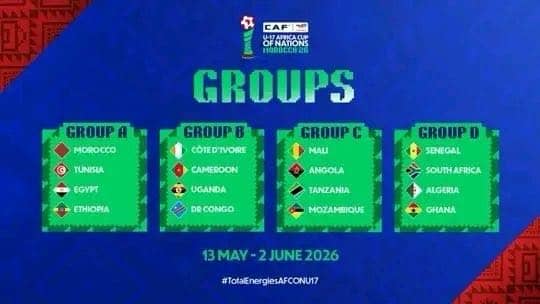
Defending champions and hosts Morocco national football team headline Group A alongside regional rivals Tunisia national football team and Egypt national football team, with Ethiopia national football team completing the group.
Group B is widely seen as one of the most competitive, featuring former champions Côte d’Ivoire national football team and Cameroon national football team, alongside Uganda national football team and debutants DR Congo national football team.
In Group C, last year’s runners-up, the Mali national football team will face the Angola national football team, the Tanzania national football team, and the Mozambique national football team.
Group D presents another heavyweight line-up, led by the Senegal national football team, with the South Africa national football team, the Algeria national football team, and two-time winners, the Ghana national football team all targeting deep runs in the competition.
Beyond continental silverware, the stakes extend to global qualification. The eight quarter-finalists will automatically secure places at the FIFA U-17 World Cup in Qatar later in the year, while third-placed teams will compete in playoffs for two additional slots.
With ten African nations ultimately expected to represent the continent on the global stage, Morocco 2026 is shaping up as more than a tournament it is a structural shift in how African youth football is staged, experienced, and developed.