Micah Jonah
February 8, 2026
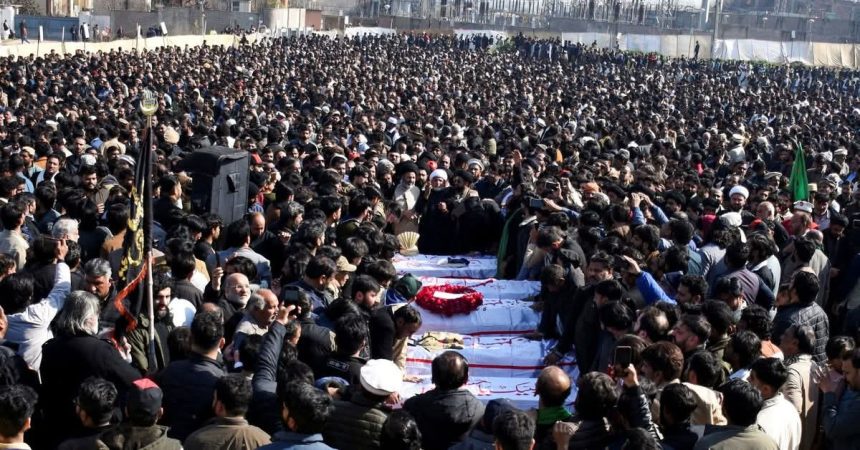
Thousands of mourners gathered in Pakistan’s capital, Islamabad, on Saturday as burial rites began for victims of a deadly suicide bombing at a Shi’ite Mosque that killed at least 31 people during Friday prayers. Authorities tightened security across the city amid fears of further attacks.
The attack occurred at the Khadija Tul Kubra Imambargah on the outskirts of Islamabad, where an assailant opened fire before detonating an explosive device inside the mosque compound. More than 170 people were injured, several of them critically, according to hospital officials.
Security agencies said the Islamic State group claimed responsibility for the bombing, describing it as the deadliest attack in Islamabad in more than a decade. Although the capital is one of Pakistan’s most heavily guarded cities, the incident has heightened concerns over a resurgence of militant violence in major urban centres, following another bombing in recent months.
Police checkpoints were set up across key roads and sensitive locations as funeral prayers were held under tight security. Elite security personnel were deployed around religious sites, government buildings and hospitals treating the wounded.
Government officials said additional security measures were being implemented to prevent further incidents. Authorities also confirmed progress in tracking those suspected of facilitating the attack, though details were not disclosed.
Shi’ite Muslims, a minority in predominantly Sunni Pakistan, have repeatedly been targeted in sectarian attacks over the years by extremist groups. Saturday’s mass funeral drew large crowds, with mourners expressing grief and anger as coffins were carried for burial.
Hospitals in Islamabad said they were continuing to treat dozens of injured victims, with major surgeries already conducted on those in critical condition. Medical officials noted that emergency resources were stretched but remained sufficient to manage the situation.
Meanwhile, law enforcement agencies carried out overnight raids in multiple locations, including Peshawar and Nowshera, arresting several suspects believed to be linked to the attack. Security sources confirmed that investigations were ongoing and that multiple agencies were involved in dismantling the network behind the bombing.
The attack has renewed calls for stronger intelligence coordination and sustained action against extremist groups, as Pakistan grapples with ongoing security challenges despite years of counterterrorism efforts.